 SeaMemo
Knots to mph and km/h: how to convert speed at sea
A knot is one nautical mile per hour, which is exactly 1.852 km/h or about 1.151 mph. To convert knots to mph, multiply by 1.151; to go from mph to knots, divide by 1.151. A quick mental shortcut: add 15 percent. 6 knots is roughly 6.9 mph.
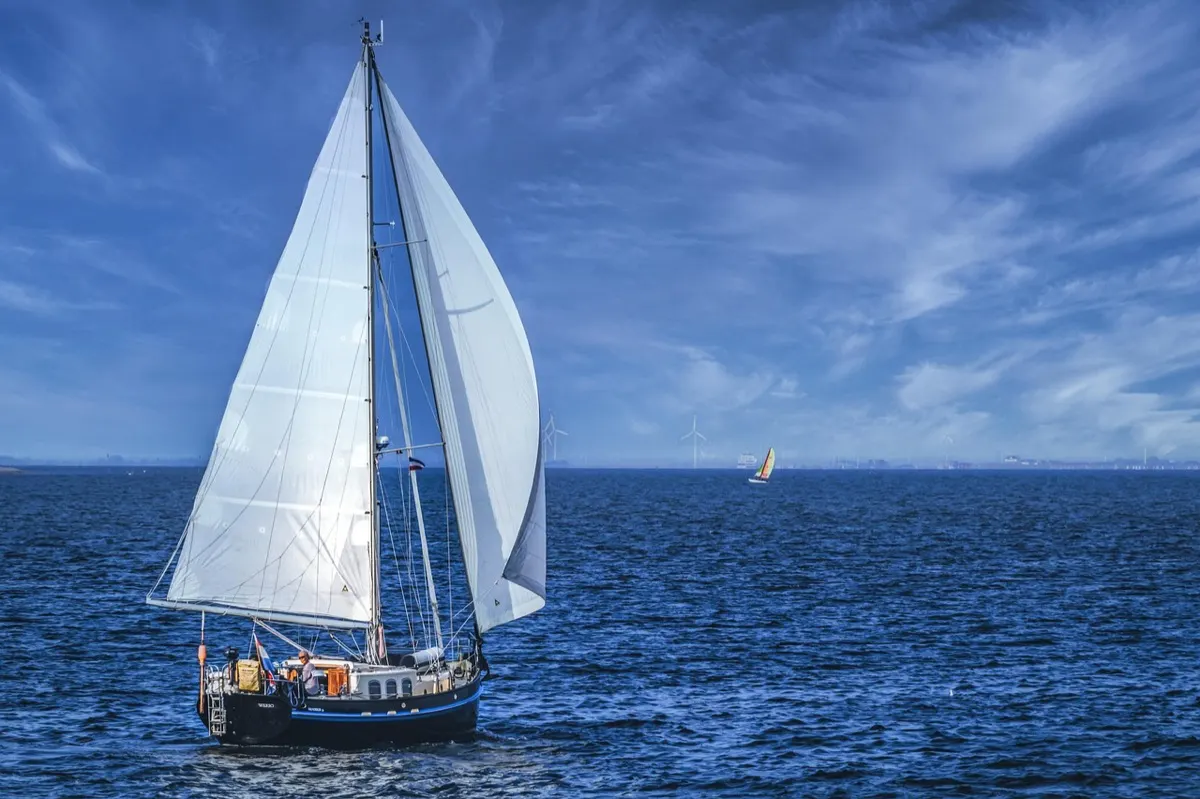
The formula: 1 knot = 1.151 mph = 1.852 km/h
A knot (kn) is not a distance but a speed: one nautical mile per hour. A nautical mile is exactly 1,852 metres, so:
- Knots to mph: knots × 1.151
- mph to knots: mph ÷ 1.151 (or × 0.869)
- Knots to km/h: knots × 1.852
- Knots to m/s: knots × 0.514, so roughly half
The UK Met Office gives the same factors with its Beaufort scale (multiply by 1.15 for mph, 0.514 for m/s), and the US NIST conversion tables list 1 knot as 0.514444 m/s (sources below).
Rule of thumb
Knots to mph: add 15 percent. 6 knots plus 0.9 gives 6.9 mph. Knots to km/h: double it and take off a tenth. 6 × 2 = 12, minus 1.2 is 10.8 km/h; the exact figure is 11.1. Close enough for a chat in the cockpit.
Knots converter
Type into any field and the others update instantly.
Conversion chart: knots to mph, km/h and m/s
Typical speeds for sailing and motor boating, rounded to two decimals:
| Knots | mph | km/h | m/s |
|---|---|---|---|
| 1 kn | 1.15 mph | 1.85 km/h | 0.51 m/s |
| 2 kn | 2.30 mph | 3.70 km/h | 1.03 m/s |
| 3 kn | 3.45 mph | 5.56 km/h | 1.54 m/s |
| 4 kn | 4.60 mph | 7.41 km/h | 2.06 m/s |
| 5 kn | 5.75 mph | 9.26 km/h | 2.57 m/s |
| 6 kn | 6.90 mph | 11.11 km/h | 3.09 m/s |
| 7 kn | 8.06 mph | 12.96 km/h | 3.60 m/s |
| 8 kn | 9.21 mph | 14.82 km/h | 4.12 m/s |
| 10 kn | 11.51 mph | 18.52 km/h | 5.14 m/s |
| 12 kn | 13.81 mph | 22.22 km/h | 6.17 m/s |
| 15 kn | 17.26 mph | 27.78 km/h | 7.72 m/s |
| 20 kn | 23.02 mph | 37.04 km/h | 10.29 m/s |
| 25 kn | 28.77 mph | 46.30 km/h | 12.86 m/s |
| 30 kn | 34.52 mph | 55.56 km/h | 15.43 m/s |
Why do sailors use knots?
Because of the chart. One nautical mile equals one minute of latitude, so you can measure distances with dividers straight off the latitude scale on the side of the chart. Sailing in knots keeps the arithmetic simple: 5 knots means 5 nautical miles in one hour. With mph or km/h you would have to convert every time you plan a passage. There is more on the unit itself in what counts as a sea mile.
The name goes back to the days before GPS: sailors threw a wooden chip log overboard on a line with knots tied at equal intervals, and counted how many knots ran out through their hands in a fixed time. That count was the boat's speed.
Passage time: distance divided by speed
For passage planning the most useful sum is not mph but how long you will take:
- Time in hours = distance in nautical miles ÷ speed in knots
- Distance = speed × time, for example 6 kn × 4 h = 24 NM
- Average speed = distance ÷ time, for example 19 NM in 3 h 7 min gives 6.1 kn
Example: the next anchorage is 30 nautical miles away and you expect to average 5 knots. That is 6 hours. Add a margin, because wind, waves and current change your speed all the time. If you are planning a long passage or a mile building trip, use a cautious average.


How fast is a sailboat? Hull speed
A typical cruising yacht is a displacement hull: it pushes water aside and struggles to go much faster than a certain speed, however much wind or engine power you add. This hull speed depends mainly on waterline length. The common rule of thumb:
Hull speed in knots ≈ 1.34 × √(waterline length in feet), or 2.43 × √(waterline length in metres)
| Waterline | Hull speed | in km/h |
|---|---|---|
| 8 m | 6.9 kn | 12.7 km/h |
| 10 m | 7.7 kn | 14.2 km/h |
| 12 m | 8.4 kn | 15.6 km/h |
| 14 m | 9.1 kn | 16.8 km/h |
It is an approximation, not a hard limit. Planing motor boats, light racing yachts and catamarans can go much faster, and even a cruising yacht surfing down a wave will briefly show more. Your average over a whole day will usually be noticeably lower.
Speed over ground or through the water?
There are two speeds on board, and they are easy to mix up:
- Speed through water (STW) comes from the log under the hull. It shows how fast the boat moves through the water and helps with sail trim.
- Speed over ground (SOG) comes from GPS. It shows how fast you are actually moving over the seabed.
The difference is the current. If the log reads 6 knots and you have 1.5 knots of foul tide, you only make 4.5 knots over the ground. For your arrival time and for the miles you log, speed over ground is what counts. What belongs in the log book is covered in how to keep a sailing logbook.
Wind speed: the Beaufort scale in knots
Most weather apps for sailors show wind in knots, and marine forecasts often use Beaufort. The table links the two. Knots and descriptions are from the UK Met Office, km/h from the German weather service DWD.
| Force | Description | Knots | km/h |
|---|---|---|---|
| 0 | Calm | < 1 | < 1 |
| 1 | Light air | 1 to 3 | 1 to 5 |
| 2 | Light breeze | 4 to 6 | 6 to 11 |
| 3 | Gentle breeze | 7 to 10 | 12 to 19 |
| 4 | Moderate breeze | 11 to 16 | 20 to 28 |
| 5 | Fresh breeze | 17 to 21 | 29 to 38 |
| 6 | Strong breeze | 22 to 27 | 39 to 49 |
| 7 | Near gale | 28 to 33 | 50 to 61 |
| 8 | Gale | 34 to 40 | 62 to 74 |
| 9 | Strong gale | 41 to 47 | 75 to 88 |
| 10 | Storm | 48 to 55 | 89 to 102 |
| 11 | Violent storm | 56 to 63 | 103 to 117 |
| 12 | Hurricane | 64+ | 118+ |
Keep in mind: wind speed says nothing about boat speed. A yacht sailing upwind is usually much slower than the wind itself.
For every force with a calculator, wave heights and what it means under sail, see our guide to the Beaufort scale.
Record your speed and sea miles automatically
On board, the only sums left are for planning. SeaMemo's GPS tracking records route, nautical miles, duration and speed of every leg, in the background, easy on the battery and without a signal at sea. Each leg shows your average in knots, and your sailor profile collects sea miles, hours at sea, night miles and your fastest leg. Comparing apps? The best sailing logbook apps lists what matters.
Knots you tie: sailing knots
If you were looking for knots in a rope rather than speed: we explain the bowline, figure eight, clove hitch and cleat hitch step by step in our guide to sailing knots.
Sources
- NIST Guide to the SI, Appendix B.8: 1 knot = 0.514444 m/s, 1 nautical mile = 1,852 m
- Met Office: Beaufort wind force scale: Beaufort in knots, factors for mph and m/s
- Deutscher Wetterdienst: Beaufort scale (German): km/h values
- Wikipedia: Knot (unit) and Hull speed
Get SeaMemo for free
Logbook, travel journal and crew in one app. For iPhone and Android, works offline at sea.


Frequently asked questions
How many mph is 1 knot?
1 knot is about 1.151 mph. A knot is one nautical mile (1,852 metres) per hour, and a statute mile is 1,609.344 metres, so 1,852 divided by 1,609.344 gives 1.15078.
How do I convert mph to knots?
Divide mph by 1.151, or multiply by about 0.869. 20 mph is roughly 17.4 knots.
How fast is 10 knots?
10 knots is 11.51 mph, 18.52 km/h or about 5.1 metres per second.
Why are boat speeds measured in knots?
Because nautical charts work in nautical miles: one nautical mile equals one minute of latitude. Sailing in knots lets you work out distance and time straight from the chart. The name comes from the old chip log, a line with knots tied at equal intervals.
How fast does a sailboat go?
A displacement yacht rarely goes much faster than its hull speed. A common rule of thumb is 1.34 times the square root of the waterline length in feet, or 2.43 times the square root in metres. For a 10 metre (33 ft) waterline that is about 7.7 knots.
What is the difference between SOG and STW?
SOG (speed over ground) is what your GPS measures. STW (speed through water) is what the log or paddle wheel measures. The difference is the current.